

Research brief | Hexa Media AI for NGOs Workshop, May 2026
Before we ran a single session of our AI for NGOs Course, we asked participants to tell us where they were starting from. What tools had they tried? What was keeping them up at night about their communications work? And what did they most hope AI could do for them?
The answers were more honest and more instructive than we expected. This brief summarises what we found.
Who participated
Twelve nonprofit communications professionals completed the pre-workshop survey, drawn from the 15 participants who enrolled in Cohort 1 of the Hexa Media AI for NGOs Course in May 2026. Respondents came from four countries: Nigeria (8), Kenya (2), Zimbabwe (1), and Sierra Leone (1).
Their roles spanned Executive Director, Founder, Communications Coordinator, Programme Lead, Fundraising Coordinator, and Legal/HR Professional. Their organisations work across children’s education, climate and health, rural health equity, girls in underserved communities, youth and women’s leadership, and IT education.
Where they started: technology comfort
Participants rated their overall comfort with technology tools on a scale of 1 to 10 before the workshop began.
The average score was 8.1 out of 10.
Scores ranged from 4 to 10, with a mode of 8. Only one respondent rated themselves below 6, and three gave a perfect score of 10. This cohort arrived digitally confident, which made the next finding all the more significant.
AI awareness before training
100% of respondents had already used an AI tool before attending the workshop.
Not some. All twelve. The tools they had tried included ChatGPT, Gemini, Claude, DeepSeek, Grok, Canva AI, Nanobanana, and Kling. ChatGPT was the most common entry point, followed by Gemini and Claude.
Several participants described their experiences positively but flagged a common struggle: prompt technique. They were getting into the tools. They just weren’t sure how to get the most out of them.
This is a critical finding. The challenge facing nonprofit communicators in Africa is not access to AI. It is structured skill development and the confidence to apply these tools consistently and well.
When asked about their current social media workflow, the picture confirmed this:
50% have a loose plan, but it is inconsistent. 25% are barely posting at all right now, 17% post when they have time and inspiration 8% have a defined team system with clear roles
Three-quarters of respondents have no consistent publishing rhythm. The tools exist. The time and structure do not.
The challenges they came with
We asked participants to rate the difficulty of six core communications challenges on a scale of 1 to 5. Here is how they ranked:
- Getting engagement on social media: 4.4 out of 5
- Writing compelling donor and funder communications: 3.6 out of 5
- Producing reports and newsletters: 3.4 out of 5
- Telling impact stories effectively: 3.3 out of 5
- Working within a small or zero communications budget: 3.3 out of 5
- Writing content consistently: 3.0 out of 5
Getting engagement on social media scored highest by a significant margin. This is not a technology problem or a content problem. It is a strategy and consistency problem, and it is one that structured AI adoption can meaningfully address.
The second-ranked challenge, donor and funder communications, confirms something practitioners in the field know well: writing for funders is a distinct skill that feels fundamentally different from general content creation. The stakes are higher, and the format is unfamiliar to many.
That impact storytelling ranks fourth despite being the core purpose of most of these organisations highlights a gap between lived experience and communications capacity that the sector cannot afford to ignore.
What they feared most about AI
We asked one open question: What is your biggest worry or concern about using AI in your communications work?
These are the answers, reproduced verbatim and anonymised.
“Using AI and still maintaining the human tone. Not sounding robotic.” — Communications coordinator, Nigeria
“People noticing that I used AI. I feel like I use AI in almost everything and that can be hard.” — Communications and media strategist, Kenya
“Confidentiality, correctness.” — Legal/HR professional, Nigeria
“Overdependence.” — Founder, Nigeria
“I am more excited about AI.” — Executive Director, Nigeria
Notice what is absent from these responses: nobody feared losing their job. Nobody worried that AI would make them redundant. The fears are subtler and more professional, a concern about authenticity, about dependency, about being seen to cut corners.
These are the concerns of communicators who take their craft seriously and care deeply about the communities they serve. They are also, we would argue, exactly the right questions to be asking.
What this tells us
African nonprofit communicators are not behind. They are resource-constrained. There is a difference.
They are already in the tools, already grappling with the real tensions between efficiency and authenticity, and already asking the questions that matter. What they need is not an introduction to AI; it is structured learning, practical application, and a training environment that takes their specific context seriously.
That is what the Hexa Media AI for NGOs Course is designed to deliver.
Join the conversation at SIMS 2026
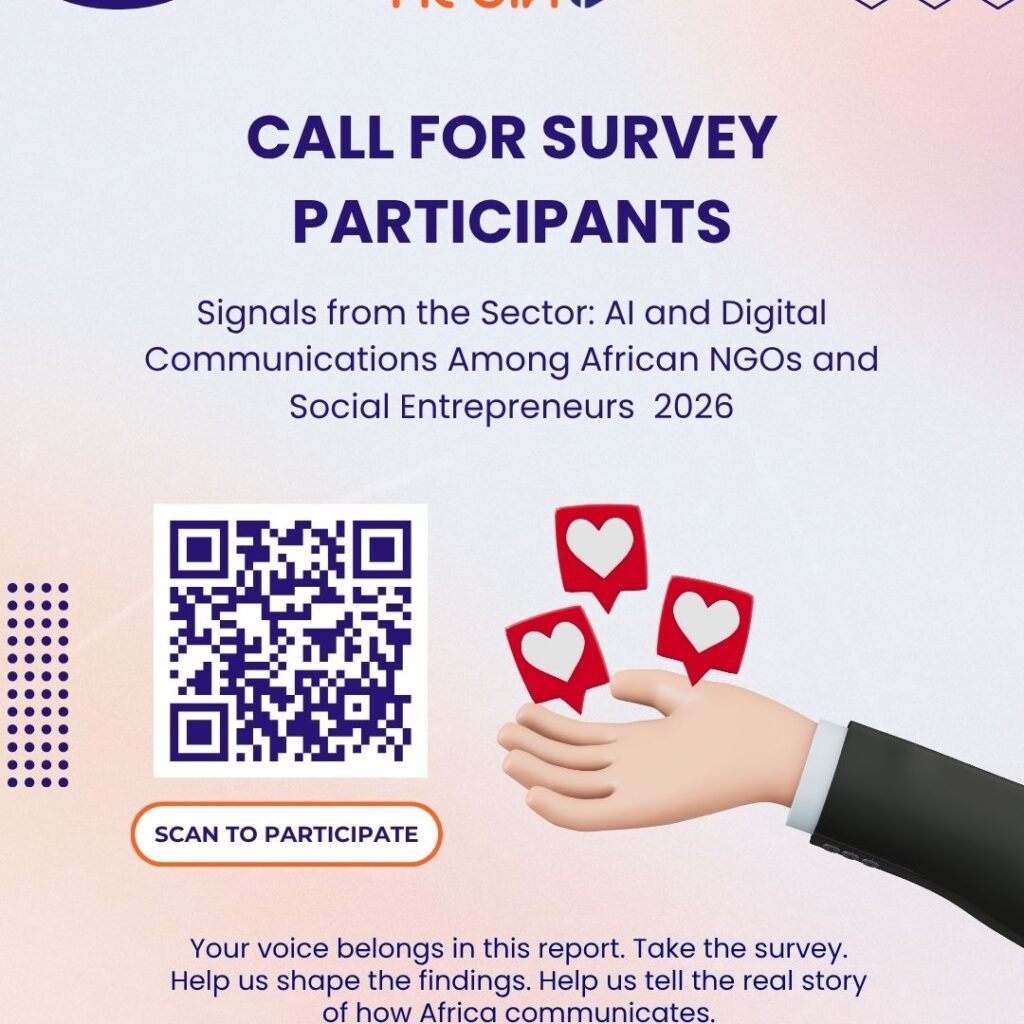
We are currently running Africa’s first sector-wide survey on AI and digital communications among NGOs. Take the survey and receive the full report free at SIMS 2026, Africa’s premier social impact marketing summit, November 2026.
About Hexa Media Africa
Hexa Media Africa is an AI-powered communications agency serving NGOs, social enterprises, and female founders across Africa. With a community of over 500 organisations across 25 African countries, Hexa Media Africa delivers communications strategy, content, and capacity building that help purpose-driven organisations be seen, trusted, and heard by the right people. Hexa Media Africa is the organiser of the Social Impact Marketing Summit (SIMS) Africa and the publisher of the Signals from the Sector research series.
Follow us on LinkedIn, Instagram, and Facebook @hexamedia.africa. Subscribe to our newsletter at hexamedia.africa